Showing posts with label Mysteries of the Universe. Show all posts

Saturday, April 26, 2025

Radar and the Raft by Jeff Lantos - OPTIONAL

Radar and the Raft: A True Story About a Scientific Marvel, the Lives it Saved, and the World it Changed by Jeff Lantos, 186 NON-FICTION Charlesbridge/Imagine, 2024. $19 

Language: G (0 swears) Mature Content: G Violence: G 

BUYING ADVISORY: MS - OPTIONAL 

APPEALS TO: SOME 

Ethel Bell and her two kids, ages 11 and 13, were lucky to secure passage on steamer to get out of Africa and home to the states when the United States entered World War II. Unfortunately, a German U-boat torpedoes their boat, which sinks in under two minutes, taking the lifeboats with it. Of the 42 souls who made it to the remaining rafts, only 18 lived to tell the story, and 17 of those were on one raft.

Between each story of the raft survivors is a chapter explaining the history of radar and the scientists who developed it. The tech behind radar sounded so far fetched that Hitler turned it down twice. Many of the scientists who worked on the final leg of radar development went to Los Alamos to work on the hydrogen bomb. " The story of the raft was interesting, though the alternating chapters were a bit jarring at first. The book is fairly science heavy. Anyone who is interested in radar would find this fascinating, though it may not be a book teens would pick up on their own. There are nice photos and watercolor prints that add to the read. May work for a science class. The Bell family is white American, and the scientists are from various parts of the world. 

Michelle in the Middle 

Friday, October 25, 2024

The Dark! Wild Life in the Mysterious World of Caves by Lindsey Leigh - ADVISABLE

The Dark! Wild Life in the Mysterious World of Caves by Lindsey Leigh
. 98 pages. NON-FICTION Penguin, 2024. $16 9780593662595 
 

BUYING ADVISORY: EL, MS - ADVISABLE 

APPEALS TO: MANY 

Everything you wanted to know and didn't know you wanted to know about caves, from cave bugs to cave leeches. 

 This is a look at the animals that live in the world's most shadowy spaces. Fully illustrated with bright colors and fun art, this book will appeal to anyone who has an interest in caves. The information is laid out logically and in an entertaining manner that will suck in readers. A great way to present nonfiction! 

Michelle in the Middle 

Sunday, January 1, 2023

Kay's Anatomy by Adam Kay - ADVISABLE

Kay’s Anatomy by Adam Kay, illustrated by Henry Paker, 408 pages. NON-FICTION. Delacorte Press (Penguin Random House). 2022.  $15.

Language: G (0 swears); Mature Content PG; Violence: G


BUYING ADVISORY: MS - ADVISABLE


AUDIENCE APPEAL: HIGH


Kay’s Anatomy bills itself as “A complete (and completely disgusting) guide to the human body.”  It lives up to its billing.  The book covers everything from how much time you spend on the toilet to whether or not boogers are safe to eat.  You will also get the lowdown on organs, skin, bones, muscles and guts, and even puberty.


The book is formatted in easy-to-read and engaging chapters with fun and informative drawings.  The chapter on the reproductive system does have drawings of both the male and female reproductive systems if that is a concern.  With lots of fun facts and the dispelling of common body myths, this is a great resource book that will suck you in as it educates.


Michelle in the Middle


Saturday, August 3, 2019

Disaster Strikes! by Jeffrey Kluger - ESSENTIAL

Disaster Strikes! The Most Dangerous Space Missions of All Time by Jeffrey Kluger, 218 pages. NON-FICTION. Philomel Books (Penquin), 2019, $19.

Language: PG (2 swears); Mature Content: PG; Violence PG

BUYING ADVISORY: MS, HS - ESSENTIAL

AUDIENCE APPEAL: HIGH

Space can be beautiful and terrible, peaceful yet deadly.  This book tells the story of disasters in space during the height of the space race from both Russian and American astronauts.  Some disasters were averted and while some ended tragically. There are twelve chapters, each with a photo and the name of the craft involved. 

This book was an intense read with well-chosen details, so I learned something new even from stories I knew, but they were succinct.  The dialogue comes directly from transcripts and recordings and is well researched. The result is a fascinating look at ingenuity, courage, and what it must be like to face the most amazing yet terrifying journey of a lifetime.  This is a riveting must-read for anyone who has ever wanted to be an astronaut or been fascinated by the vastness of space.   

Michelle in the Middle, Teacher


Monday, January 28, 2019

Digging Deep: How Science Unearths Puzzles from the Past by Laura Scandiffio - OPTIONAL


Digging Deep: How Science Unearths Puzzles from the Past by Laura Scandiffio, 103 pages.  NON-FICTION Annik Press, 2019.  $15.  

Content: Language: G; Mature Content: G; Violence: PG.  

BUYING ADVISORY: MS, HS – OPTIONAL  

AUDIENCE APPEAL: AVERAGE  

This book covers six different discoveries in archeology that modern science has been able to uncover more facts about.  The discoveries include Otzi the Iceman, an ancient poison, a lost city in Cambodia, lost ships in the Arctic, the lost grave of Richard III and the Chauvet Cave art.  Each chapter has a story involving the topic and then it has a section about how modern archeologists can use different technology or testing to determine facts about history that we haven’t known before.  At the end of the chapter there is a summary about what that discovery has changed about our perceptions of history.  

I wanted to love this book because its subtitle had me totally intrigued, but it is so wordy and dense that it takes patience to wade through the information.  It is interesting, and certain chapters were more entertaining than others (the Richard the III chapter read like a mystery), but I’m not sure students would be compelled to continue to read.  Also, I have an ARC and the pictures were blurry and unattractive, which I’m sure will be cleaned up for the final book, but I think the pictures will either make or break readers interest.  

Reviewer, C. Peterson   

Saturday, January 5, 2019

Seeing Stars: A Complete Guide to the 88 Constellations by Sara Gillingham - ADVISABLE

Seeing Stars: A Complete Guide to the 88 Constellations by Sara Gillingham. PICTURE BOOK/NON-FICTION. Phaidon, 2018. $25. 9780714877723

BUYING ADVISORY: EL, MS, HS - ADVISABLE

AUDIENCE APPEAL: HIGH

There is a little background to the history and use of constellations, but the bulk of the book is a catalog of each constellation. Each two page spread includes a full page illustration of the constellation, a description of where the stars are located, how to find it, and a story or legend associated with the image made up by the stars. 

Books don’t get much more beautiful than this one. The cover of the book is a beautiful matte finish with holes punched out for all the stars. The illustrations are all limited to three key colors, but it feels aesthetically soothing. I think this book will appeal to students interested in the night sky and would be fun to use as a school club on astronomy. 


Jen Wecker, HS English Teacher

Thursday, November 29, 2018

One Day a Dot: The Story of You, the Universe, and Everything by Ian Lendler - ESSENTIAL

One Day a Dot: The Story of You, the Universe, and Everything by Ian Lendler, illustrated by Shelli Paroline and Braden Lamb. PICTURE BOOK. First Second (Roaring Book Press), 2018. $18. 9781626722446.

BUYING ADVISORY: EL, MS - ESSENTIAL

AUDIENCE APPEAL: AVERAGE

Starting with the appearance of a simple dot, that then got so excited it burst into lots of other dots, that then joined together and made light, and eventually...the world as we know it came to be and we all exist. This is a simplified--and fantastic!--explanation of evolution, taking the readers from the very beginnings all the way to their own life on earth today. The author leaves us with the one thing no one can agree on or explain today--where that first dot actually came from.

I liked this the first time I read it, and loved it the next time I gave it a go. The illustrations are colorful, artsy, and perfect for the material. The way a somewhat complex topic like evolution is simplified down here is great and I can see many a science teacher using this book. This should be in every school library and science teacher's bookshelf.

Reviewer: TC

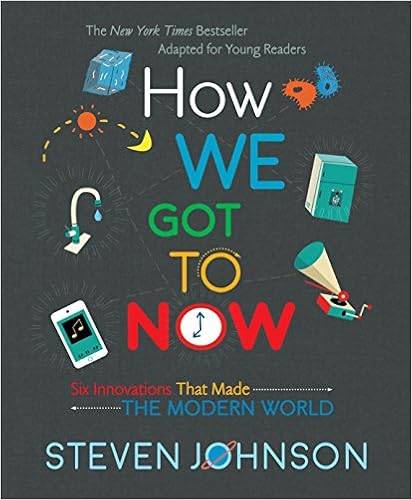
How We Got To Now: Six Innovations That Made The Modern World by Steven Johnson - ESSENTIAL

How We Got To Now: Six Innovations That Made The Modern World by Steven Johnson, 152 pages. NON-FICTION. Viking (Penguin), 2018. $20
978-0-425-28778-1

Language: G (0 swears); Mature Content: PG; Violence: G.

BUYING ADVISORY: EL, MS, HS - ESSENTIAL 

AUDIENCE APPEAL: AVERAGE

This book is a young reader adaptation from a New York Times bestseller and covers the discoveries and innovations surrounding glass, cold, sound, cleanliness, time, and light. Each chapter covers one of these topics and includes a comprehensive history with the logistical details embedded in the timeline. The chapters also contain a number of photographs and illustrations. There are a lot of attention grabbing anecdotes in each section.  

My entire family loved this book. We jumped around the book, each taking a turn picking a topic, and learned a lot in the process. One of the anecdotes that we have retold to other people we read in the chapter on light and it tell the story of how whale oil was used to make cheaper candles. To get the oil, or spermaceti, they had to send a small person, often a child, inside the body of the whale to scoop out gallon after gallon of the substance. Gross. This would be a fun informational text to read aloud in a science, history, or English classroom.        


Jen Wecker, HS English Teacher

Sunday, December 31, 2017

Rise of the Lioness by Bradley Hague-OPTIONAL


Hague, Bradley, Rise of the Lioness. Pgs. 56. National Geographic, 2016. $18.99. INFORMATION.

In Western Zambia, the habitat is perfect for wildebeasts, zebras, and lions. Poaching and war, however, have damager the wilderness and reduce the lion population. How can people make a difference? How have these lions adapted?

A story of survival, the author takes a look at the ecosystem, the history of the issue, as well as the rebuilding of it, tracking of animals, and the reintroduction of animals into the ecosystem.  The layout is well done and does a great job of introducing the plight of the lions. The primary sources include photographs, stories, and more. Included are an afterward, a glossary, and an index. Readers interested in lions, animal, and the wild will enjoy reading this book.

MS. OPTIONAL.  Reviewer: Jessica M, Library Media Specialist, Olympus Jr. High.

Wednesday, December 27, 2017

The Human Microbiome by Rebecca E. Hirsch-ADVISABLE


Hirsch, Rebecca E., The Human Microbiome: The Gerns That Keep You Healthy. Pgs. 112. Lerner Publishing, 2017. $34.65. INFORMATION

Inside your cheeks, your nostrils, and throughout your body, are cities of microbes. A small number are unhealthy germs, but most protect you from dangerous germs, digest your food, and other essential jobs. Using DNA sequencing, scientists in recent years have been able to further understand how food and microbe-killing drugs can affect us. In this book, the author discusses how these germs do these essential jobs and more.

The layout is slightly text-heavy, but the information provided is objective, informative, and intriguing. The author includes primary sources like old photographs, diagrams, and illustrations to explain various concepts in an easy to understand format. Included are a glossary, source notes, bibliography, sources for further information, and an index to use with common core standards.

MS, HS - ADVISABLE. Reviewer: Jessica M, Library Media Specialist, Olympus Jr. High

Saturday, October 21, 2017

Impact! Asteroids and the Science of Saving the World by Rusch - ESSENTIAL

Rusch, Elizabeth Impact! Asteroids and the Science of Saving the World (Scientists in the Field), 63 pages.  Houghton Mifflin, 2017.  $19.

Did you know that one hundred tons of space rock land on Earth every single day?  But since most of it is dust, we hardly ever notice it.  But there are hundreds of scientists all over the world working hard to detect and possibly deflect earth-shattering asteroids from hitting us and causing an era-ending catastrophe like the one that ended the dinosaurs. 

Rusch introduces us to a few of the people and much of the science that surrounds learning about and keeping us safe from asteroids.  Introduce your students to excellent information about scientists, male and female, working in this space science field.

EL, MS – ESSENTIAL.  Cindy, Library Teacher

Wednesday, August 12, 2015

Head Lice by Elise Gravel-OPTIONAL

Gravel, Elise, Head Lice. Random House, 2015. $12.99. INFORMATION


What is Head Lice? How do you get them? What do they eat? This book answer these questions and more in this fun, basic fact picture book. The illustrations are colorful bring the text in fun, humorous ways. This book is a great read aloud for helping kids of all ages to understand these scary insects. EL (K-3). OPTIONAL. Reviewer: Jessica M, Library Media Specialist, Olympus Jr. High.

Frozen in Time by Mark Kurlansky-OPTIONAL

Kurlansky, Mark, Frozen in Time. Pgs. 165. Random House, 2014. $15.99. INFORMATION.


Ever wondered how the frozen food in your freezer came to being? When one opens the freezer, they might not think about how someone had to invent that technology, but the invention of it is almost a miracle in itself. From his observations of how Native American tribes preserved food to the development and selling of the technology shortly before the Stock Market Crash of 1929 all came together with impeccable timing. This book is the story of this instrumental frontier technology and how it forever changed the world. A fascinating, engaging book with great use of facts, primary sources, and knowledge of history. Readers who are interested in the food process or who need to read a non-fiction book will enjoy reading this book. Included are a bibliography and index for further investigation. MS, HS. OPTIONAL. Reviewer: Jessica M, Library Media Specialist, Olympus Jr. High. 

Saturday, May 23, 2015

Running Dry: Global Water Crisis by Stuart Kallen-ADVISABLE


Kallen, Stuart A., Running Dry: Global Water Crisis. Pgs. 64. Twenty First Century Books (Lerner Publishing Group), 2015. $33.32. INFORMATION.

About 1 out of every 9 people in the world doesn’t have access, to safe drinking water. Climate changes, massive storms, and industrial and agricultural pollution are just a few of the factors threatening the water supply and public health around the world. What is the world doing to fix the problem? What can you do? This book addresses these questions and more.

Although the book is heavily bias towards environmental reasons, the author does a great job of presenting the facts in a user-friendly fashion. The text and photos complement each other well. The intermixed fact bubbles are fun and informative. Included are source notes, further information links, and index for use with meeting common core standards. Readers interested in current issues or who need to read a non-fiction book will enjoy reading this book. MS, HS. ADVISABLE. Reviewer: Jessica M, Library Media Specialit, Olympus Jr. High.

Wednesday, October 2, 2013

The Wells Bequest by Polly Shulman - ADVISABLE

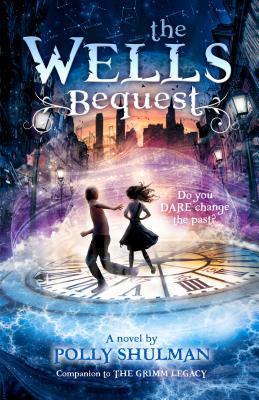
Shulman, Polly. The Wells Bequest. 253 pages.  Nancy Paulsen Books (Penguin), 2013.  $16.99. Content: G.  A companion novel to the charming The Grimm Legacy, which is well worth a read, but doesn’t need to be read first.  The narrator is Leo, a self-deprecating, smart kid who feels out of place in a family of geniuses.  His whole world changes when a miniature Leo appears on a time machine with a beautiful girl.  His mini-me from the future tells him to read The Time Machine by H. G. Wells.  A science project leads him to the New York Circulating Materials Repository (a kind of library for things), where he meets a life-sized version of the beautiful girl.  Her name is Jaya and she is the head page.  In an attempt to get to know Jaya better, Leo begins a job as a page and soon learns that there are all sorts of magical and scientifically impossible items at the library—including a time machine.  While the novel’s pacing is steady and plot imaginative, the book is a little quark-y.  “Quark” is not a misspelling; it’s a scientific term that is used as a creative cuss word.  There are a whole lot of scientific terms and science fiction literary references.  The time travel is actually only a very small part of the book, which disappointed me as a reader.  The “bad-guy’s” motivation seemed contrived and his overall character never convinced me.  The two main characters, however, are positively delightful and make reading it worthwhile. 
MS,  HS—Advisable.  Samantha Hastings, MA, MLS. 

Friday, June 28, 2013

The Mystery of Darwin’s Frog by Martha Crump - ADVISABLE


Crump, Martha L.  The Mystery of Darwin’s Frog, 38 p. Boyds Mill Press, 2013.  $17.  Content: G.  NONFICTION.  

During his world travels, Darwin found a frog that no one in his scientific world had ever recorded.  Through the decades, many scientists have added bits of information to the body of work about these frogs, including the author of this book.  Besides being a child friendly look at the frogs, this is also an great example of scientific method, resource sharing and working to protect an endangered species.  Teachers should look at this to add to their science curriculum.  

EL, MS – ADVISABLE.   Cindy, Library Teacher